
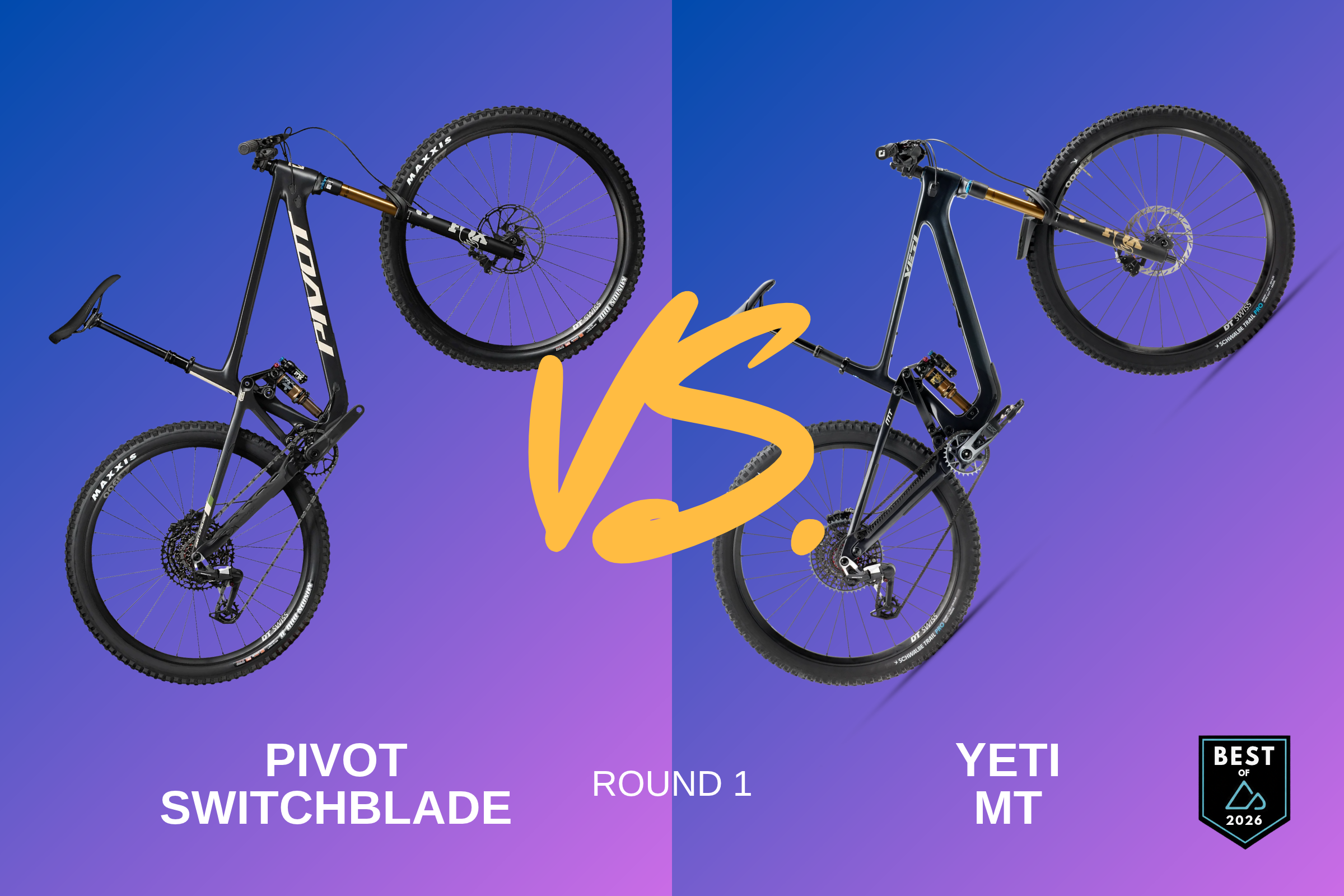
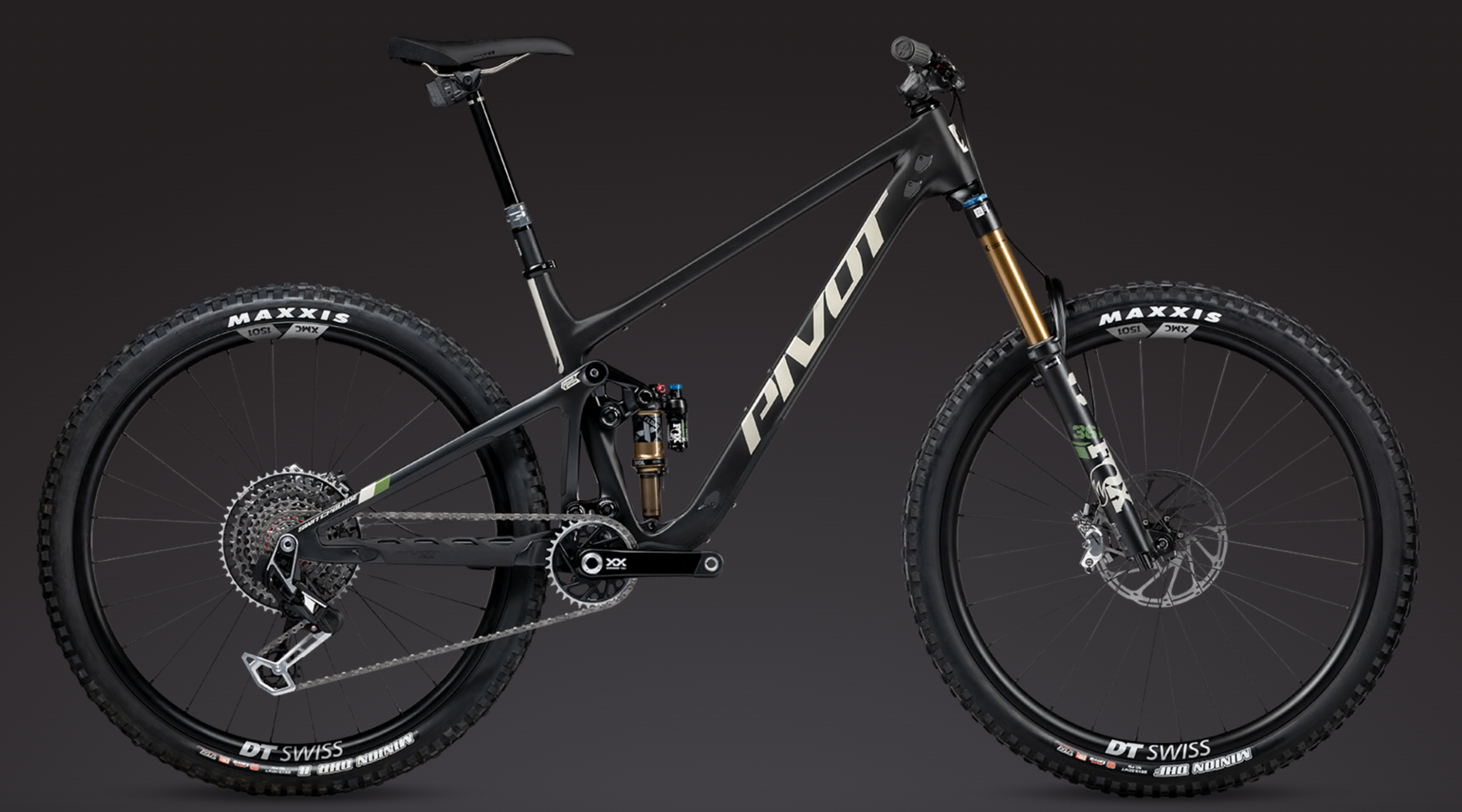
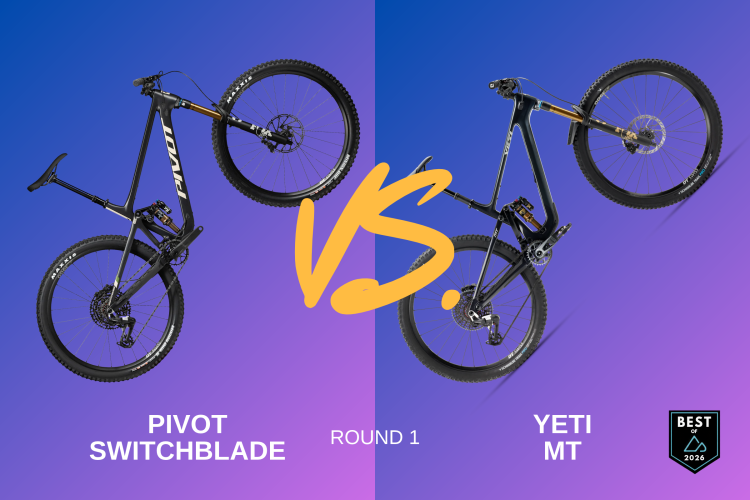
The Pivot Switchblade and Yeti MT are long-travel trail bikes, sitting just before each brand’s proper enduro offerings. With nearly identical suspension numbers, both bikes aim to maintain efficient pedaling platforms while prioritizing descending capabilities, and they do so with very comparable builds, down to wheel choice.
Though the builds may be nearly the same and the marketing-speak similar, the geometry numbers tell a different story, likely pointing to where each bike shines. But if the geo numbers don’t lead you to choose one over the other, the price might — roughly $1,300 separates these two bikes.
This matchup is part of the 2026 trail bike of the year tournament. For each head-to-head, we’re focusing on travel, geometry, suspension, and frame features. We’ll also look at build and price differences, generally selecting the SRAM Eagle 90 build or equivalent for each bike.
| Yeti MT X0/90 | Pivot Switchblade Ride Factory | |
| Suspension travel (F/R) | 160/140mm | 160/142mm |
| Drivetrain | SRAM Eagle 90 | SRAM Eagle 90 |
| Suspension | Fox Factory 36 Grip X2, Fox Factory Float X | Fox Factory 36 Grip X2, Fox Factory Float X |
| Geometry*(size large frame) | HTA: 64.5° STA: 77° Reach: 480mm Chainstay: 446mm | HTA: 65.7°/65.2° STA: 76.5°/76° Reach: 485/480mm Chainstay: 431/432mm |
| Weight | 32.41lb | |
| Price | $8,000 | $6,699 |
Travel and category positioning
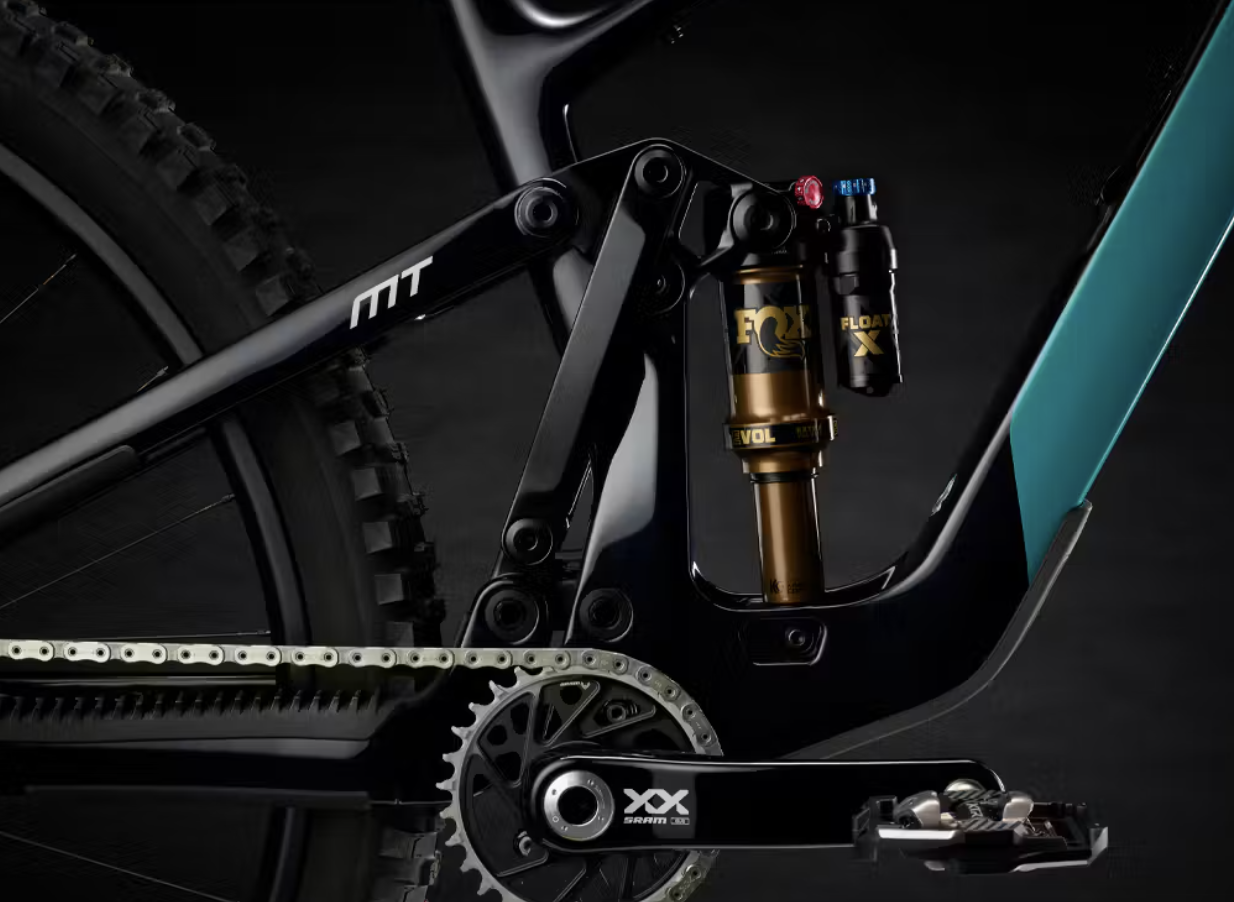
Travel numbers alone put the Pivot Switchblade and Yeti MT within millimeters of each other — exactly 2mm, in fact. Both bikes feature a 160mm-travel fork, with the Switchblade boasting 2mm more rear travel than the MT — 142mm and 140mm, respectively.
A year ago, we would have been discussing fairly similar takes on twin-link suspension platforms. Pivot, of course, equips the Switchblade with DW-Link suspension, while Yeti used its Switch Infinity platform on bikes like the SB 140 until this year. That changed, however, with Yeti’s introduction of the MTe and LTe e-bikes, followed by the LT enduro bike and, eventually, the MT, which replaced the SB 140. All four bikes ditched the Switch Infinity package for a six-bar platform appropriately named Sixfinity.
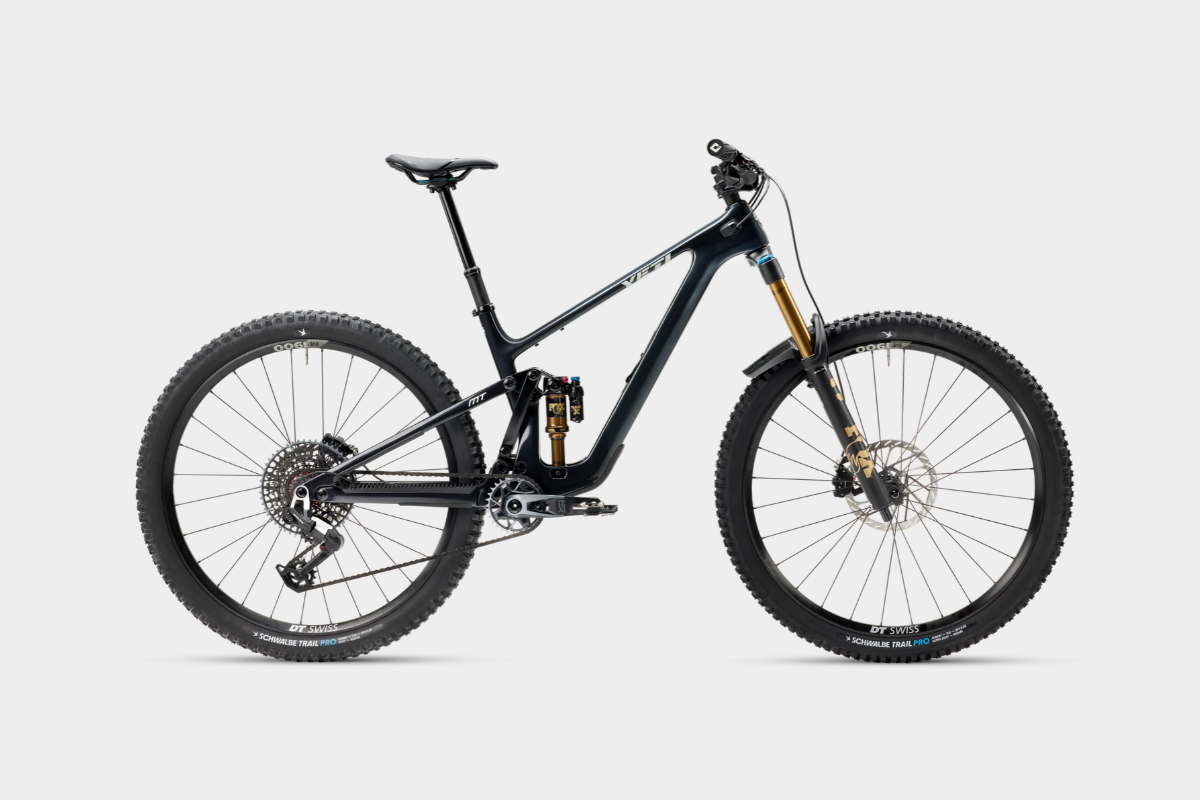
Yeti moved to Sixfinity because a six-bar platform is more tunable. According to Yeti, “Sixfinity gives riders unprecedented traction, composure while pedaling, and superior efficiency.” The result is an MT that Yeti says will have you finding your own limits before you find the bike’s. With a legacy in racing and sponsorship of some of the world’s fastest riders, Yeti aimed the MT to do just that — be pushed hard and ridden fast.
Pivot, similarly, calls the Switchblade a bike “built for riders who demand total versatility, combining playful agility with big-terrain composure.” They also note that the Switchblade “climbs efficiently,” which we noted when we reviewed the bike in 2024, along with stellar composure over square-edged hits.
So, with “do it all” claims on both sides, what separates the Switchblade and MT? The geometry numbers differentiate the two bikes more than anything else.
Geometry numbers show two pretty different bikes
While travel numbers and suspension platforms point to two bikes that are efficient pedalers and capable decenders, the bikes’ geometry may hint at where each truly shines. For starters, the Yeti MT’s headtube angle (HTA) is nearly 1 ° slacker than the Pivot Switchblade—actually, at 64.5°, it is 1.2° slacker than the Switchblade in the “high” geo setting.
The seat tube angle is also about 1° steeper on the MT compared to the Switchblade. It is also a significantly longer bike. A 446mm rear center gives the MT a wheelbase of 1,263mm on a size large — 14mm longer than the Switchblade’s 432mm chainstays and 21mm longer than the 1,242mm wheelbase.
For the most part, a few millimeters here or there isn’t really noticeable. Chainstays that are 14mm longer? A bike that is 21mm longer overall? Yeah, that is going to be noticeable. A longer rear end, slacker front, and overall longer bike typically improve descending stability and confidence, likely giving the MT the edge over the Switchblade when the tires are pointed downhill.
A shorter, steeper bike like the Switchblade should ultimately be more playful, as Pivot claims. That said, the Switchblade has a taller front end than the MT, with a 643mm stack height versus 635mm. The taller stack could help compensate for a steeper HTA, pushing the rider back a touch, and aiding descending performance.
Both bikes have some adjustability
For the most part, what you see is what you get with the Pivot Switchblade and the Yeti MT. While both bikes have some adjustability, the changes are relatively limited compared to other long-travel trail bikes available — some of which are in this grouping.
For the Yeti MT, adjustability is limited to shock progressivity settings. The MT has three progression settings at the lower shock mount: 10%, 15%, and 20%. Yeti says that 10% is for a “racy and consistent” feel, while 20% is “plush then poppy,” with the “balanced” 15% setting in the middle.
Aside from a headset size that accepts reach-adjusting headsets, the progressivity flip chip is the only adjustment on the MT. The bike rolls on 29-inch wheels front and rear only.
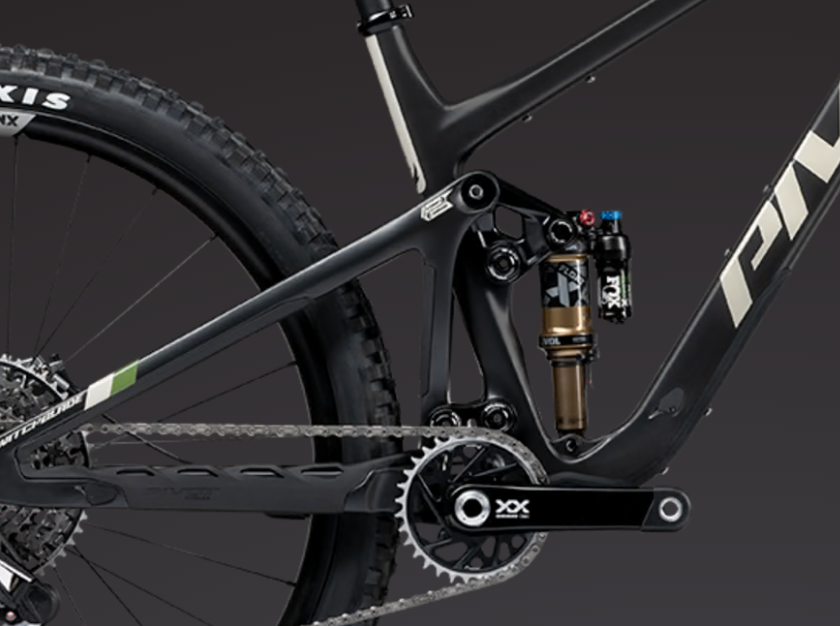
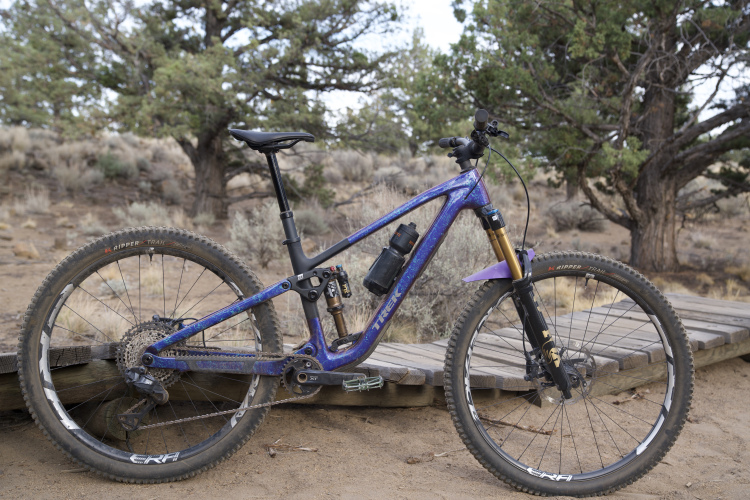
The Pivot Switchblade, on the other hand, can run mixed-wheels. Though it comes as a dual 29er, the high/low flip chip allows for a smaller rear wheel without compromising geometry. While Pivot ships the bike in the low setting, you can also switch between high and low settings with dual 29-inch wheels to find what best suits your terrain and riding style. The change is roughly 0.5° steeper/slacker, +/- 6mm at the bottom bracket, and +/- 5mm for reach.
Frame features
Yeti uses its TURQ carbon fiber across all builds on the new MT. The MT also features “internally tunneled” cable routing, a threaded bottom bracket, sealed enduro max pivot bearings, a UDH, and boost rear spacing.
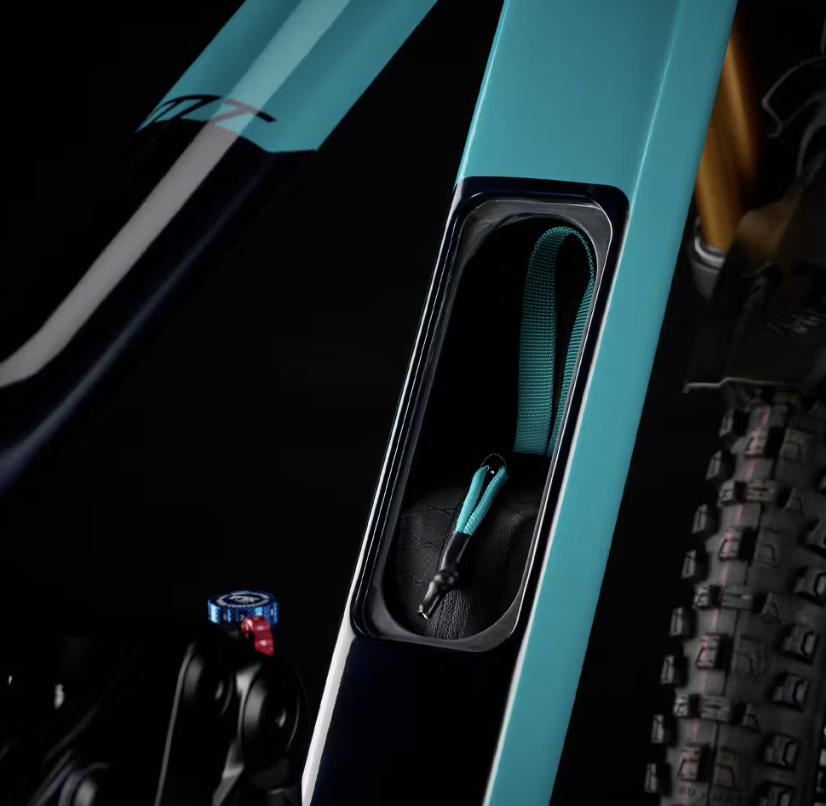
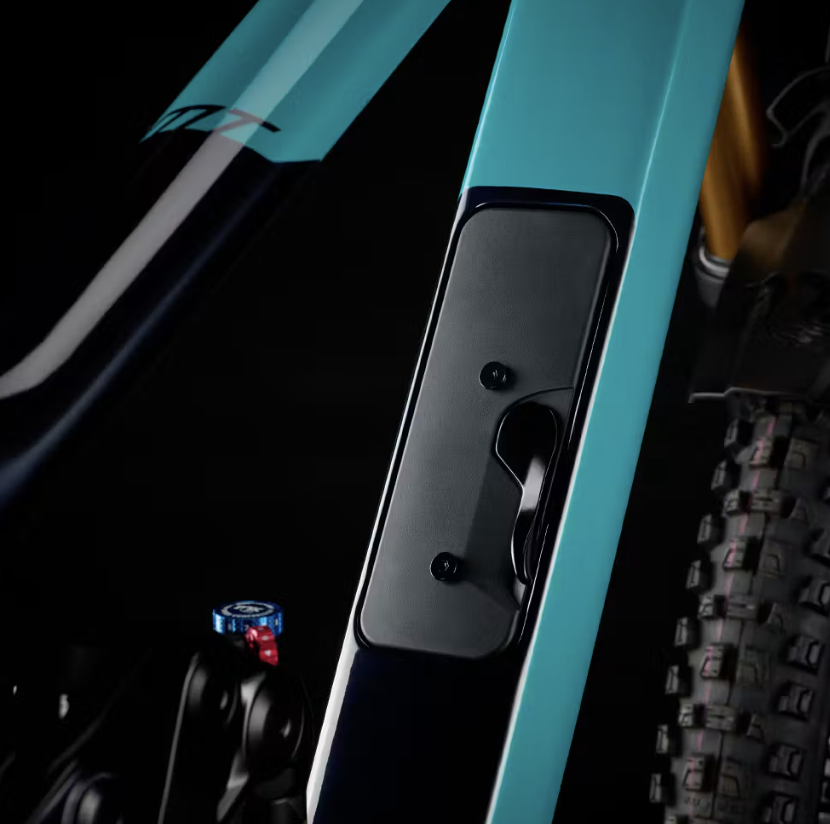
The MT has internal frame storage and an accessory mount on the underside of the top tube. Yeti also incorporates size-specific chainstays into the MT size range with fairly meaningful changes between sizes. A size small frame has 436mm stays, increasing to 440mm on a medium, 446mm on a large, and 452mm on an extra-large.
The Pivot Switchblade’s chainstays are somewhat size-specific, but only on the larger sizes. Sizes extra-small through medium all feature 431mm chainstays, while a size large has 432mm and an extra-large has 436mm — the same chainstay length as a small MT.
Pivot uses its Ultra-Light Hollow Core carbon for the frame, tuning each size specifically. The frame has “hassle-free” internal cable routing via the Pivot cable port system, a UDH, and accessory mounts under the top tube rather than in-frame storage.
Another thing to note: Pivot uses 157mm Super Boost rear spacing.
Build kits and the bottom line
Both bikes also have essentially the same build. Beyond the identical Fox Factory Suspension and Eagle 90 drivetrains, they feature the same DT Swiss M1900 wheels. Brakes are the biggest differentiator between the MT and Switchblade builds: the former gets SRAM Maven Silvers, and the latter gets DB8 Stealth.
But are the Maven Silver brakes and in-frame storage worth the extra $1,300? If you need a brake upgrade, you can likely find a better deal for less than that. So, geometry will likely tell the difference.
As a slacker, longer bike, the Yeti MT should offer a bit more stability and confidence when descending, while the Pivot Switchblade promises a more versatile, playful character on the trail.
So, which bike do you think should be pushed to round 2?
We’ll reveal which bike moves on to round two on November 11, when the winner takes on either the Specialized Stumpjumper or the Trek Fuel EX.
The news stinks. Why not follow Singletracks on Google News to bring more joy to your day?





0 Comments